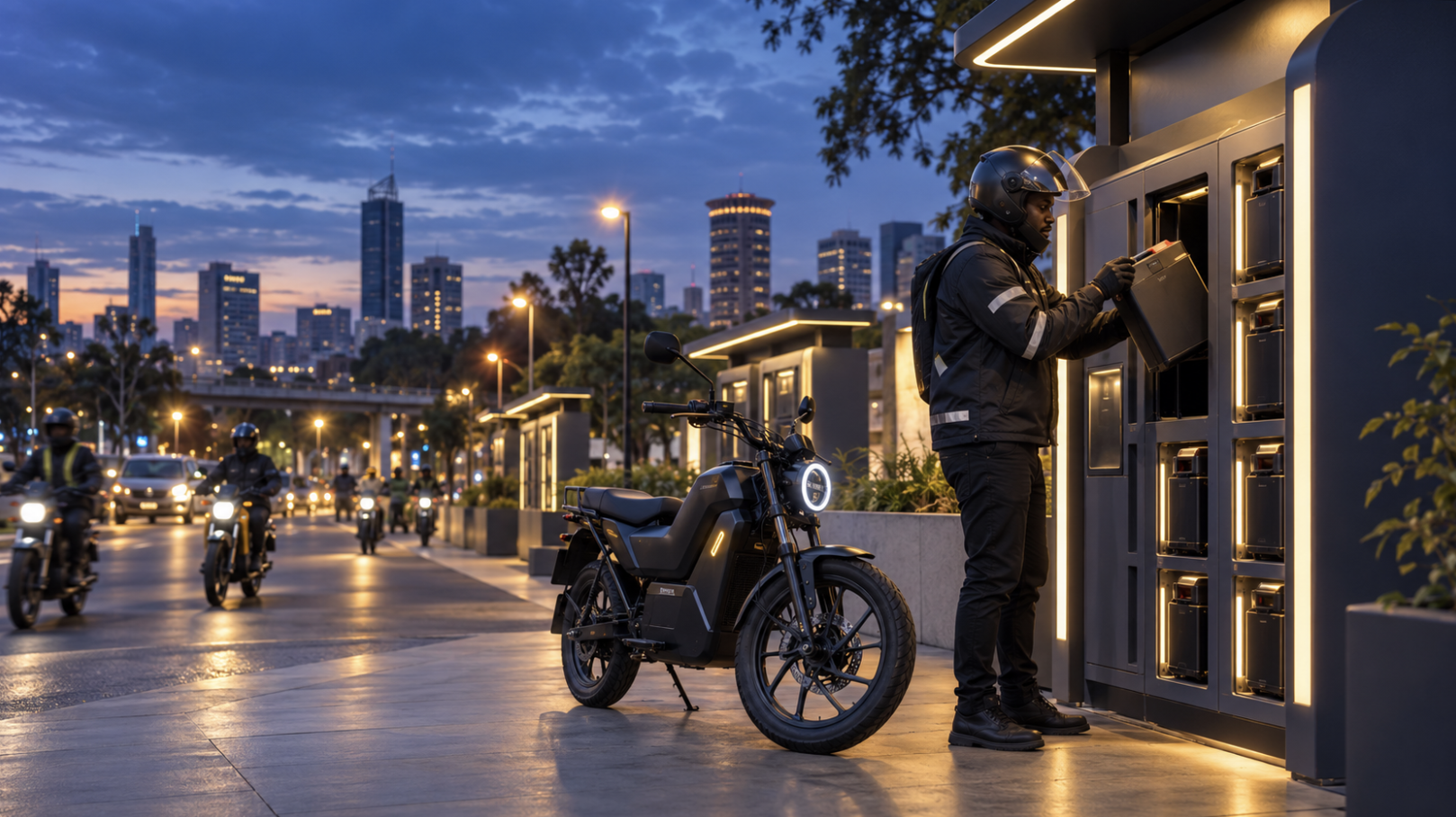
The Nairobi-born company is not simply selling electric motorcycles. It is trying to build the energy network on which an entire category of vehicles could run.
ARC Ride has secured $33.3 million to expand its electric-mobility operations across Africa, in one of the continent’s largest recent investments in battery-swapping infrastructure.
The financing combines approximately $23 million in Series A equity with $10 million in debt. Novastar Ventures and Norrsken22 led the equity round, joined by the International Finance Corporation, British International Investment and Proparco. Existing investors Musashi Seimitsu and Talanton also participated, while BII’s Kinetic programme and Mirova provided debt financing.
The money will support the deployment of 5,000 electric motorcycles, expansion of ARC Ride’s battery-swapping network and entry or growth in South Africa, Uganda, Tanzania and Ghana. The company will also strengthen its existing Kenyan operations.
But the more important story is not the number of motorcycles ARC Ride plans to put on the road. It is the infrastructure the company hopes those motorcycles will use.
The motorcycle is only the entry point
ARC Ride operates a Battery-as-a-Service model. Riders use electric motorcycles without having to purchase the battery outright, then exchange depleted batteries for charged ones at automated swapping stations.
This addresses two of the largest obstacles to electric-motorcycle adoption.
The first is acquisition cost. Batteries are among the most expensive components of an electric vehicle. Separating the battery from the motorcycle can make the vehicle more affordable for riders.
The second is downtime. A commercial motorcycle cannot generate income while spending several hours connected to a conventional charger. Battery swapping reduces that interruption by allowing a rider to exchange batteries within minutes.
For boda boda riders, this is not merely a technology question. It is a question of daily earnings, operating costs and reliability.
The company’s network currently includes automated swapping cabinets, maintenance facilities and battery-management technology. It is also working with manufacturers such as Yadea, which has identified ARC Ride as a Kenyan ecosystem partner for electric motorcycles and battery swapping.
Why the funding structure matters
The combination of equity and debt is significant.

Motorcycles, batteries and swapping stations are physical assets that require substantial upfront investment. Financing this entire expansion through venture-capital equity would be expensive and could heavily dilute existing shareholders.
Debt can finance assets that generate predictable recurring income, while equity pays for market entry, technology development and the organizational capacity required to scale.
This is the logic behind ARC Ride’s financing package: growth capital for the platform and asset-backed financing for the hardware.
It also indicates that investors are beginning to evaluate African electric mobility as an infrastructure business rather than simply an early-stage technology experiment.
Proparco, which invested $1.5 million in the equity round, says the project could create more than 300 direct jobs and approximately 2,900 indirect jobs over time. It also projects that replacing petrol-powered vehicles could avoid around 100,000 tonnes of carbon emissions annually. These are forward-looking estimates rather than achieved outcomes, but they show the economic and environmental case being presented to development investors.
The real competition is for network density
Electric-mobility companies often promote vehicle range, battery performance and fuel savings. Those factors matter, but battery swapping introduces another source of competitive advantage: network density.
A rider is more likely to adopt an electric motorcycle if a charged battery is reliably available near the routes where they work. Each additional station makes the network more useful. More riders then make it economical to install more stations.
That creates a network effect.
The company that builds the most dependable and conveniently located swapping network could become difficult to displace, particularly if multiple motorcycle manufacturers adopt its battery specifications and charging system.
This explains Norrsken22’s argument that ARC Ride could eventually become an open standard for electric mobility across Africa. The larger opportunity is not necessarily controlling every motorcycle. It is providing the energy and technology layer used by many vehicle brands.
However, that ambition creates a strategic tension. Manufacturers may hesitate to depend on infrastructure controlled by a potential competitor, while rival electric-mobility companies are developing their own batteries, vehicles and swapping networks.
ARC Ride must therefore prove that its platform can be sufficiently open to attract manufacturers while remaining commercially defensible.
Five thousand motorcycles will test the model
Deploying 5,000 motorcycles will expand ARC Ride’s presence, but it will also test whether its economics work at scale.
The critical measures will not be the amount raised or the number of vehicles announced. They will include:
- Utilization of each swapping station
- Battery availability and charging uptime
- Rider retention and repayment performance
- Cost per kilometre relative to petrol motorcycles
- Maintenance and battery-replacement costs
- The amount of capital required to enter each new city
Kenya provides a promising launch market because commercial motorcycles are deeply embedded in urban and regional transport. But expansion into several countries will introduce different electricity tariffs, tax systems, transport regulations, financing conditions and rider behaviour.
A model that works in Nairobi cannot simply be copied into Accra, Johannesburg or Kampala without adaptation.
The bigger bet
ARC Ride’s financing is a vote of confidence in African electric mobility, but it does not establish that battery swapping has already won.
The company still has to demonstrate that its stations can remain highly utilized, its batteries can survive demanding commercial use and riders can save enough money to justify switching from petrol.
If it succeeds, ARC Ride could become more than an electric-motorcycle company. It could operate a distributed energy network serving several vehicle manufacturers across multiple markets.
That is the real significance of the $33.3 million raise. The motorcycles will make the network visible. The infrastructure will determine whether the business becomes defensible.