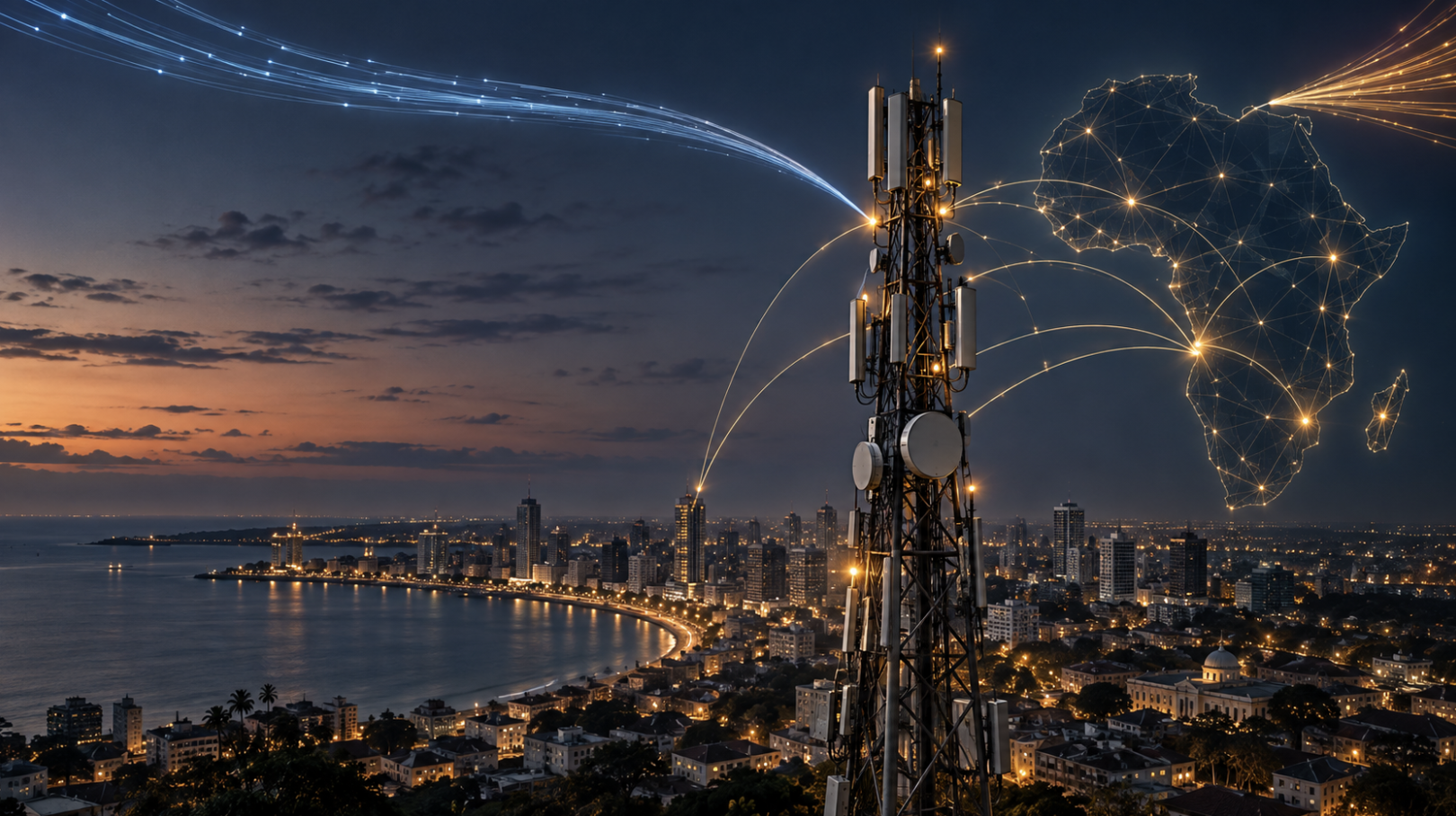
The United States is lending Africell $99.6 million to invest in American and European mobile-network technology for its Angolan operations.
It is a telecom investment with an explicitly geopolitical purpose.
The direct loan from the US Export-Import Bank supports an American-owned operator while offering an alternative to Chinese equipment, particularly Huawei’s.
Washington is no longer treating Africa’s telecommunications networks as ordinary commercial infrastructure. It increasingly sees them as strategic assets in its competition with China.
Telecom networks now carry national power
Mobile networks do much more than connect calls.

They transmit government communications, business transactions, mobile-money activity and large volumes of sensitive personal information. They also underpin cloud services, digital identification systems, artificial intelligence and connected public infrastructure.
The companies supplying this equipment therefore occupy a strategically important position.
Huawei has built a formidable African presence by combining competitive technology with financing, rapid deployment and long-term relationships with governments and operators. The company is estimated to supply approximately 52% of Africa’s 5G infrastructure, according to Counterpoint Research figures cited by Reuters.
The United States argues that dependence on Chinese telecommunications equipment could expose countries to surveillance and political pressure. Huawei denies that its technology facilitates espionage and argues that American restrictions are designed to weaken a commercial competitor.
The Africell loan moves this contest beyond diplomatic pressure. It uses public financing to promote American and allied technology in African telecommunications networks.
Financing is part of the competition

Huawei’s success in Africa has never depended on equipment alone.
Chinese lenders and state-backed institutions have helped finance telecommunications and other infrastructure projects across the continent. Technology, credit, installation and long-term support can be offered as part of a wider package.
Western governments have often urged African countries to avoid Chinese equipment without providing equally accessible financing for alternatives.
The Africell transaction begins to address that gap. Instead of relying only on sanctions and security warnings, Washington is making American and European technology easier to buy.
The loan is also a form of industrial policy. It supports Africell, the only US-owned mobile-network operator in Africa, while creating demand for Western technology suppliers.
Africell has previously worked with companies including Hewlett Packard Enterprise, Dell, Oracle and Finland’s Nokia. The company says its Angolan network is built exclusively with Western equipment.
The financing therefore advances three American objectives: strengthening a US-owned company, supporting Western technology suppliers and reducing reliance on Chinese network infrastructure.
Why Angola matters
Africell operates in Angola, the Democratic Republic of Congo, Sierra Leone and The Gambia, serving more than 15 million subscribers. But the new financing is specifically intended for Angola.
That makes the geopolitical context more important.
Angola sits at the centre of the Lobito Corridor, a transport and logistics network intended to connect mineral-producing regions in Angola, Zambia and the Democratic Republic of Congo to the Atlantic coast. The United States and its partners are backing the corridor partly as an alternative to infrastructure and supply chains dominated by China.
Although the Africell loan has not been formally presented as part of the Lobito Corridor programme, a Western-backed telecommunications network in Angola complements Washington’s wider infrastructure strategy.
Modern ports, railways, mines and logistics systems depend on connectivity, cloud infrastructure, digital payments and secure data transmission. Physical and digital infrastructure can no longer be treated as separate strategic categories.
Taken together, these investments suggest that Washington is trying to build a broader commercial ecosystem across strategically important parts of Central and Southern Africa.
Vendor choice is not digital sovereignty
The loan will be presented as an investment in trusted and secure communications. But choosing Western equipment over Chinese technology does not automatically give an African country digital sovereignty.
It may reduce dependence on one geopolitical power while creating dependence on another.
Real digital sovereignty requires governments and operators to control the rules surrounding their infrastructure. That includes strong data-protection laws, cybersecurity standards, transparent procurement, the ability to audit critical systems and sufficient local expertise to operate and maintain them.
It also requires diversified supply chains. Depending too heavily on any one vendor can leave operators exposed to price increases, licensing restrictions, software dependencies and political decisions made abroad.
The important question is therefore not simply whether equipment comes from China, the United States or Europe. It is whether the arrangement improves national resilience and strengthens the buyer’s negotiating power.
Africa could still benefit from the rivalry
Greater competition between technology suppliers could benefit African operators.
If the United States and its allies provide more affordable financing, operators may gain credible alternatives when procuring equipment. That could improve pricing, reduce dependence on a single supplier and accelerate network upgrades.
But these outcomes are not guaranteed.
The Africell loan will not automatically make mobile data cheaper, extend coverage to underserved communities or improve service quality. Those results will depend on what Africell purchases, where it deploys the equipment and how the investment changes network capacity.
Nor will one loan substantially weaken Huawei’s position. Africell operates in four countries, while Chinese technology is embedded across much of the continent.
The transaction is better understood as a demonstration of intent. Washington is showing that it is prepared to use public capital, not just security arguments, to promote its preferred digital infrastructure.
Africa should negotiate from the competition
The growing contest over African telecommunications creates both risk and leverage.
The risk is that African countries become arenas for a geopolitical struggle in which infrastructure choices are shaped more by Washington and Beijing than by local development priorities.
The opportunity is that rivalry could widen access to capital and technology.
African governments and operators should use that competition to demand better terms: lower financing costs, stronger cybersecurity safeguards, transparent contracts, open network architecture, local skills development and clear rules on data governance.
They should also resist replacing one form of technological dependence with another.
America’s Africell loan shows that telecommunications networks have become instruments of foreign policy, industrial strategy and national security.
The financing may come from Washington and the equipment from Western companies. But African countries should ensure that the connectivity, capability and strategic value created remain under their control.